Our website uses cookies which are necessary for running the website and for providing the services you request. We would also like to set the following optional cookies on your device. You can change these settings any time later by clicking "Change cookie settings" at the bottom of any page. For more information, please read our Cookie Information.
These cookies collect information such as how many people are using our website or which pages are popular, helping us improve the customer experience. Disabling these cookies means we won’t be able to collect information to enhance the experience.
These cookies help us understand what interests you so we can show you relevant ads on other websites. Disabling these cookies means we will not be able to show you personalized ads.
A smart water network is a modern approach used by water utilities to monitor, control, and optimize water distribution systems using connected devices, sensors, and data platforms. It brings together infrastructure such as pipes, pumps, meters, and control systems with digital tools that analyze real-time information from the field.
The main objective is to improve visibility across the water network, support leak detection, and maintain consistent water quality while improving operational efficiency for cities and service providers.
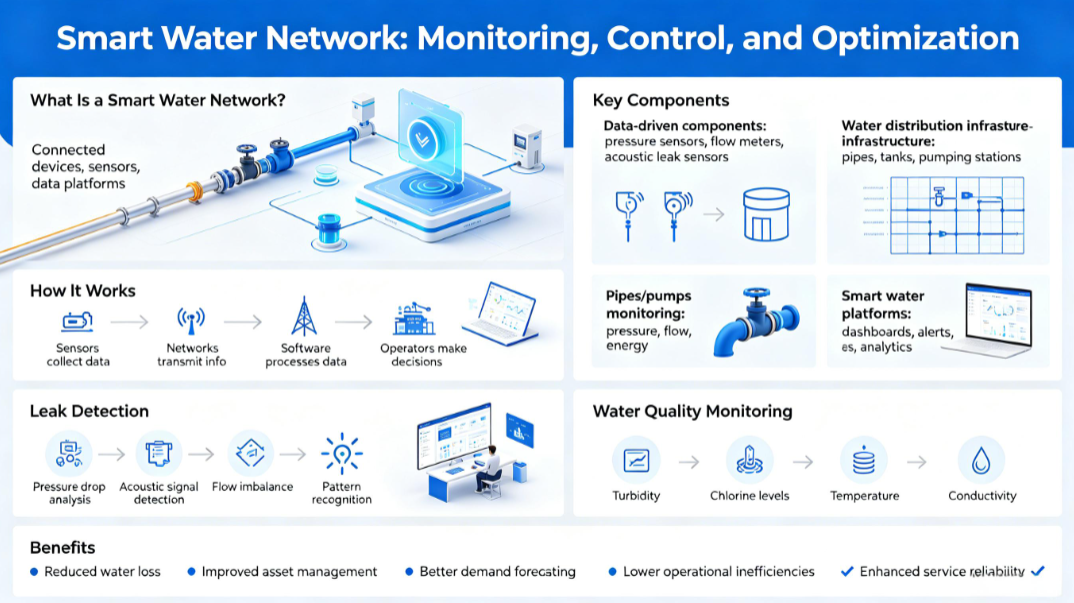
A smart water network connects physical assets with digital systems:
This structure supports smart water management by turning raw operational data into usable insights.
Modern systems rely on data driven components such as pressure sensors, flow meters, and acoustic leak sensors. These devices continuously collect information from the field, helping operators understand what is happening inside the network without manual inspection.
The backbone of any system remains the water distribution grid, including transmission mains, service pipes, storage tanks, and pumping stations. Smart upgrades add monitoring points across this infrastructure.
Pipes pumps are continuously tracked for pressure fluctuations, abnormal flow, and energy consumption. This allows utilities to detect inefficiencies or early signs of failure.
Software platforms aggregate incoming data and present it in dashboards. These systems support smart water decision-making, including alerts and predictive analysis.
One of the most widely used applications is leak detection. Traditional methods often rely on visible signs or manual inspection, while smart systems identify leaks earlier through:
Early detection reduces water loss and supports more stable network performance.
Maintaining water quality is another key function. Sensors placed in distribution lines measure parameters such as:
This continuous monitoring helps identify contamination risks and ensures compliance with regulatory standards.
Real time data enables faster response to network changes. Instead of relying on periodic reports, operators can observe live conditions across the entire system.
This includes:
Real-time visibility supports more stable water network performance.
Smart water management combines monitoring, analytics, and automation. It allows utilities to:
Instead of reactive maintenance, operators shift toward planned, data-informed actions.
Modern water utilities adopt smart water systems in several areas:
These applications help utilities manage growing demand and aging infrastructure.
Even though smart water systems offer many advantages, implementation may involve:
The evolution of smart water networks is moving toward:
As cities grow, data-centric infrastructure will continue shaping how water utilities operate.
A system that uses sensors and digital tools to monitor and manage water supply systems in real time.
It uses pressure, flow, and acoustic data to identify abnormal patterns that indicate leaks.
Sensors, IoT devices, data analytics platforms, and communication networks.
It allows immediate response to issues like leaks, pressure drops, or contamination risks.
They reduce water loss, improve efficiency, and enhance system reliability across the network.
