Our website uses cookies which are necessary for running the website and for providing the services you request. We would also like to set the following optional cookies on your device. You can change these settings any time later by clicking "Change cookie settings" at the bottom of any page. For more information, please read our Cookie Information.
These cookies collect information such as how many people are using our website or which pages are popular, helping us improve the customer experience. Disabling these cookies means we won’t be able to collect information to enhance the experience.
These cookies help us understand what interests you so we can show you relevant ads on other websites. Disabling these cookies means we will not be able to show you personalized ads.
Efficient flow monitoring is one of the foundations of modern water treatment operations. Whether managing potable water production, wastewater processing, or industrial water reuse systems, plant operators rely on accurate flow data to optimize performance, control costs, and maintain regulatory compliance.
Among the various flow measurement technologies available, the electromagnetic flow meter has become a widely adopted solution in both water and wastewater applications. Known for its high accuracy, reliability, and ability to measure a conductive fluid without mechanical components, this technology helps treatment facilities improve operational efficiency across multiple stages of the treatment process.
This article explains how electromagnetic flow meters work, where they are used in treatment facilities, and how they contribute to better plant performance and long-term cost savings.
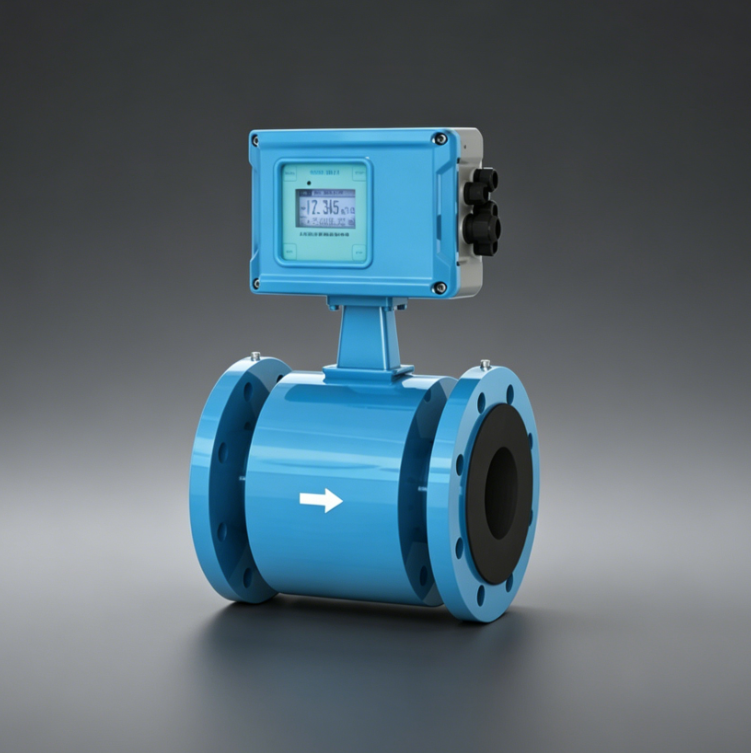
An electromagnetic flow meter, often called a magnetic flow meter, measures the velocity of a conductive liquid flowing through a pipe using the principle of electromagnetic flow measurement.
The technology is based on Faraday's Law of Electromagnetic Induction. As a conductive fluid moves through a magnetic field generated by the meter, a voltage induced across electrodes is detected and converted into flow data.
The generated signal is proportional to the velocity of the liquid, allowing the system to calculate flow rates accurately.
The measurement process involves several steps:
Because water and wastewater typically contain dissolved ions, they are suitable conductive fluids for electromagnetic measurement.
Every treatment plant depends on accurate flow measurement to monitor incoming and outgoing water volumes.
Flow data supports:
Even small measurement deviations can affect treatment efficiency and operating costs over time.
This is why many facilities choose water treatment flow meter technologies capable of delivering stable performance under changing operating conditions.
Before treatment begins, facilities need to measure the amount of incoming water.
Electromagnetic flow meters installed at intake pipelines help operators:
Accurate measurements provide a clear picture of overall plant loading.
Multiple treatment stages require continuous monitoring.
Examples include:
Flow measurement data allows operators to adjust process parameters according to actual operating conditions.
After treatment, water enters the distribution network.
Electromagnetic flow meters measure:
These measurements support accurate reporting and operational planning.
Electromagnetic technology is equally valuable for wastewater flow measurement.
Wastewater systems often contain suspended solids, organic materials, and varying flow conditions that can challenge other flow technologies.
Because electromagnetic meters have no internal obstructions, they perform well in these demanding environments.
Wastewater treatment facilities use electromagnetic flow meters to measure incoming wastewater flow.
Benefits include:
Reliable influent data helps operators understand changing system conditions.
Flow measurement at discharge points is often required for environmental reporting.
Electromagnetic meters provide consistent wastewater flow measurement data that supports:
Sludge transport systems require accurate flow monitoring for process control and equipment management.
Electromagnetic flow meters can handle conductive fluids containing suspended particles, making them suitable for sludge-related applications.
One reason electromagnetic technology is widely used in water and wastewater facilities is its high accuracy.
Accurate measurements support:
Unlike some traditional flow meters, electromagnetic designs contain no moving parts inside the measuring tube.
Advantages include:
This feature is especially beneficial in wastewater flow applications where solids and debris are present.
The full-bore design allows fluid to pass through the meter without significant obstruction.
As a result:
Electromagnetic flow meters are available for a wide range of pipe diameter requirements.
Applications range from:
This flexibility allows consistent measurement technology throughout a facility.
Water treatment plants often operate under varying temperatures, flow conditions, and fluid characteristics.
Electromagnetic meters are designed to provide high performance under these demanding conditions.
Their measurement accuracy is largely unaffected by:
Some wastewater systems use open channel flow measurement instead of closed-pipe monitoring.
Electromagnetic technology can be integrated with specialized sensors and flow structures to monitor:
Accurate open channel flow data supports better system management and regulatory reporting.
Modern treatment facilities increasingly rely on automation systems for operational efficiency.
Electromagnetic flow meters often support:
Continuous access to flow measurement data enables faster operational decisions and improved resource management.
Accurate flow data directly contributes to cost savings throughout a treatment facility.
Potential benefits include:
Chemical dosing systems can be adjusted according to actual flow rates, helping avoid overfeeding.
Pump operation can be optimized using real-time flow information.
The absence of moving parts minimizes wear-related maintenance requirements.
Flow monitoring data helps operators identify bottlenecks and improve equipment utilization.
Over time, these improvements can significantly reduce operating expenses.
Several factors should be evaluated when selecting a water treatment flow meter:
Electromagnetic meters require a conductive liquid or conductive fluid to operate properly.
The selected meter must match the system's pipe diameter and expected operating range.
Facilities should choose a meter capable of measuring expected minimum and maximum flow rates accurately.
Factors such as accessibility, communication requirements, and environmental conditions should also be considered.
As water utilities and industrial facilities continue modernizing operations, flow measurement technology is evolving alongside digital infrastructure.
Emerging developments include:
Electromagnetic flow meters are expected to remain a preferred solution because of their accuracy, reliability, and compatibility with modern automation systems.
Electromagnetic flow meters help treatment facilities improve efficiency by providing reliable and accurate flow measurement across a wide range of water and wastewater applications. Their ability to measure conductive fluids without moving parts, maintain high accuracy, and support modern automation systems makes them a practical choice for today's treatment plants.
From raw water intake monitoring and chemical dosing control to wastewater flow measurement and open channel flow applications, electromagnetic technology provides the data needed to optimize operations, reduce costs, and improve overall plant performance.
An electromagnetic flow meter is a device that measures the flow of a conductive liquid by detecting the voltage induced as the fluid moves through a magnetic field.
They provide accurate flow measurement, require minimal maintenance, support automation systems, and perform well in both water and wastewater applications.
Yes. They are commonly used for wastewater flow measurement because they can handle conductive fluids containing suspended solids and other materials.
No. Electromagnetic flow meters contain no moving parts inside the measuring tube, which helps reduce wear and maintenance requirements.
They are available for a wide range of pipe diameter sizes, from small process lines to large municipal water and wastewater pipelines.
Yes. When combined with appropriate sensors and flow structures, they can be used for open channel flow monitoring applications.
They help optimize chemical dosing, improve pump efficiency, reduce maintenance requirements, and provide accurate flow data for better operational decisions.
Electromagnetic flow meters are designed to measure conductive liquids, including drinking water, wastewater, reclaimed water, sludge, and many industrial process fluids.
