Our website uses cookies which are necessary for running the website and for providing the services you request. We would also like to set the following optional cookies on your device. You can change these settings any time later by clicking "Change cookie settings" at the bottom of any page. For more information, please read our Cookie Information.
These cookies collect information such as how many people are using our website or which pages are popular, helping us improve the customer experience. Disabling these cookies means we won’t be able to collect information to enhance the experience.
These cookies help us understand what interests you so we can show you relevant ads on other websites. Disabling these cookies means we will not be able to show you personalized ads.
Choosing the right flow measurement technology is essential for achieving accurate process control, efficient operations, and long-term reliability. Among the many types of flow meters available today, the electromagnetic flow meter has become a preferred solution for water treatment plants, industrial facilities, municipal water networks, chemical processing systems, and wastewater applications.
However, successful electromagnetic flow meter selection involves more than simply matching the meter size to a pipeline. Factors such as fluid conductivity, pipe diameter, flow rate, installation conditions, liner materials, and communication requirements all influence performance.
This guide explains how electromagnetic flow meters work, what selection criteria matter most, and how to choose a high performance solution for your application.
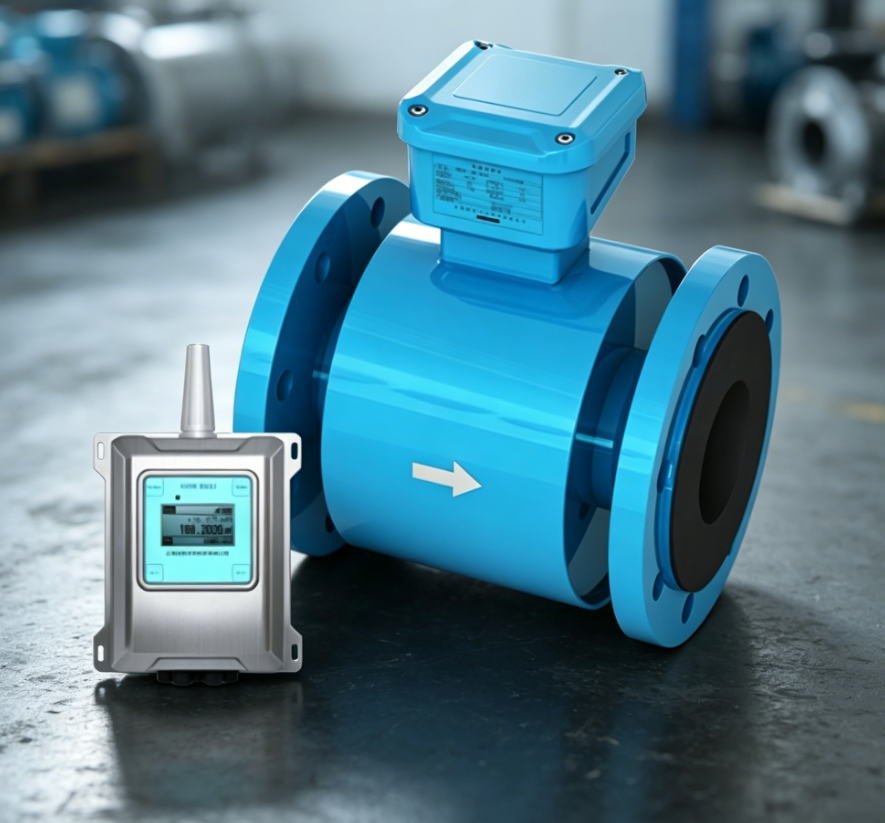
An electromagnetic flow meter, also known as a magnetic flow meter, is a device used to measure flow in pipes carrying electrically conductive liquids.
Unlike mechanical flow meters that rely on moving parts, electromagnetic flow technology uses a magnetic field and electrodes to determine liquid velocity and calculate flow.
Because there are no internal moving components, electromagnetic flow meters provide stable performance, low maintenance requirements, and minimal pressure loss.
They are commonly used for:
The operating principle is based on Faraday's Law of Electromagnetic Induction.
Faraday's law of electromagnetic induction states that when a conductor moves through a magnetic field, an electrical voltage is generated.
In an electromagnetic flow meter:
As fluid flows through the meter, the voltage induced is proportional to the velocity of the liquid.
The meter uses this signal to calculate flow rate and total volume.
Since the generated voltage is directly proportional to the velocity, electromagnetic flow measurement provides highly accurate results across a wide operating range.
One of the first considerations during electromagnetic flow meter selection is fluid conductivity.
Electromagnetic flow technology requires a conductive liquid or conductive fluid to function properly.
Suitable liquids include:
Non-conductive liquids generally cannot be measured with electromagnetic flow meters.
Examples include:
Before selecting a meter, verify that the fluid conductivity meets the manufacturer's minimum requirements.
Pipe diameter is one of the most important sizing considerations.
The meter should be selected according to the actual internal diameter of the pipeline.
Common sizes range from:
Using the correct pipe diameter helps maintain measurement accuracy and ensures proper flow velocity.
Oversized meters may reduce measurement sensitivity at low flows, while undersized meters can create excessive velocities.
Understanding the expected flow rate range is essential.
Review:
The selected meter should provide accurate measurement across the entire operating range.
Most high performance electromagnetic flow meters offer a wide turndown ratio, allowing them to measure both low and high flows effectively.
Evaluate the properties of the liquid being measured.
Consider:
These factors influence the selection of lining materials and electrode materials.
Installation conditions can affect meter performance.
Assess:
Selecting equipment designed for the operating environment improves reliability and service life.
The liner protects the meter body from corrosion and wear.
Common liner materials include:
Suitable for aggressive chemicals and high temperatures.
Often used in water and wastewater applications.
Provides good abrasion resistance for slurry applications.
Offers excellent chemical compatibility and temperature resistance.
Electrodes directly contact the conductive fluid.
Material selection depends on process conditions.
Common choices include:
Proper electrode selection improves durability and measurement stability.
Many facilities choose electromagnetic flow technology because of its operational benefits.
Electromagnetic flow meters typically provide accuracy levels between ±0.2% and ±0.5% of reading.
Without mechanical components, maintenance requirements are significantly reduced.
The full-bore design allows fluid flows with minimal restriction.
Electromagnetic flow meters can accurately measure flow across varying process conditions.
The simple internal design contributes to long-term reliability.
Utilities use magnetic flow meter systems to monitor:
Electromagnetic flow meters are suitable for measuring wastewater containing suspended solids.
Many chemical plants use electromagnetic flow measurement because it can handle aggressive conductive liquids.
Sanitary electromagnetic flow meters are widely used in food-grade liquid processes.
An industrial flow meter is often required for:
Electromagnetic flow technology supports these applications with reliable performance.
Matching the meter solely to pipe diameter without considering velocity and flow rate can reduce accuracy.
Electromagnetic flow meters cannot accurately measure non-conductive fluids.
Always verify conductivity requirements.
Liner and electrode materials must match the chemical properties of the process liquid.
Incorrect grounding, air pockets, and insufficient straight pipe runs can affect measurement quality.
Today's electromagnetic flow meters often include:
These features provide greater visibility into system performance and simplify maintenance planning.
For the best results, evaluate the following:
| Selection Factor | What to Review |
|---|---|
| Conductive Fluid | Verify conductivity level |
| Pipe Diameter | Match meter size to application |
| Flow Rate | Confirm operating range |
| Liner Material | Ensure chemical compatibility |
| Electrode Material | Select based on fluid properties |
| Installation Conditions | Assess environmental factors |
| Communication Options | Consider SCADA and automation integration |
| Accuracy Requirements | Match process needs |
| Maintenance Needs | Review lifecycle costs |
A structured evaluation process helps ensure the selected meter delivers reliable performance throughout its service life.
The next generation of electromagnetic flow meters is becoming increasingly connected.
Emerging developments include:
These technologies provide additional operational insights while maintaining the proven benefits of electromagnetic flow measurement.
Successful electromagnetic flow meter selection requires a thorough understanding of the application, fluid properties, operating conditions, and performance requirements. By applying the principles of Faraday's law of electromagnetic induction, electromagnetic flow meters accurately measure flow in conductive liquids while providing low maintenance and long service life.
Whether selecting an industrial flow meter for manufacturing, water treatment, wastewater management, or chemical processing, considering factors such as pipe diameter, flow rate, conductive fluid characteristics, and material compatibility will help ensure accurate and dependable flow measurement.
An electromagnetic flow meter is a device that uses a magnetic field and electromagnetic induction to measure flow in conductive liquids.
Faraday's law states that when a conductor moves through a magnetic field, a voltage is generated. In a flow meter, the moving conductive liquid generates a voltage induced signal that is proportional to the velocity of the fluid.
Electromagnetic flow meters can measure conductive liquids such as drinking water, wastewater, process water, chemical solutions, and slurries.
Oil is generally non-conductive and does not generate the electrical signal required for electromagnetic flow measurement.
Pipe diameter influences flow velocity and measurement accuracy. Selecting the correct meter size helps ensure reliable performance.
There is no difference. The terms electromagnetic flow meter and magnetic flow meter refer to the same technology.
Yes. Electromagnetic flow meters are widely used as industrial flow meter solutions in manufacturing, water treatment, chemical processing, and wastewater facilities.
Important factors include fluid conductivity, pipe diameter, flow rate, pressure, temperature, liner materials, electrode materials, installation conditions, and communication requirements.
