Our website uses cookies which are necessary for running the website and for providing the services you request. We would also like to set the following optional cookies on your device. You can change these settings any time later by clicking "Change cookie settings" at the bottom of any page. For more information, please read our Cookie Information.
These cookies collect information such as how many people are using our website or which pages are popular, helping us improve the customer experience. Disabling these cookies means we won’t be able to collect information to enhance the experience.
These cookies help us understand what interests you so we can show you relevant ads on other websites. Disabling these cookies means we will not be able to show you personalized ads.
Water utilities and building operators are moving toward digital measurement systems that replace traditional mechanical devices. A smart water meter is now widely used in residential, commercial, and industrial water management because it delivers continuous data on water usage and supports better operational decisions.
Unlike older meters that require manual reading, smart water metering systems monitor water in real time and transmit data automatically through communication networks. This shift supports better visibility into consumption patterns, leak detection, and cost control.
Understanding smart water meter features helps utilities and facility managers choose systems that align with long-term water management goals.
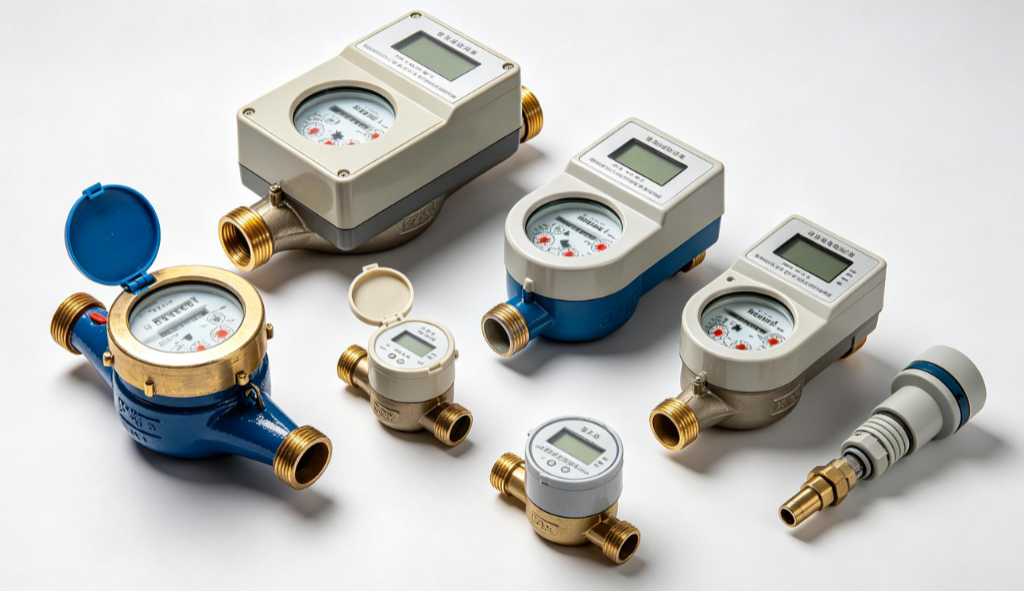
A smart water meter is a digital water meter equipped with communication technology that records and transmits water usage data automatically.
It is commonly used in:
A smart meter can function as part of an AMR water meter system or an AMI water meter system depending on the communication level and infrastructure design.
One of the main smart water meter features is real-time data collection.
The system continuously monitors water usage and sends updates to a central platform. This allows operators and users to:
Real-time visibility helps reduce uncertainty in water consumption data.
An AMR water meter (Automatic Meter Reading) collects water data and transmits it at scheduled intervals.
Key characteristics include:
AMR systems are often used as a first step in smart water metering adoption.
An AMI water meter (Advanced Metering Infrastructure) provides a more connected system compared to AMR.
It supports two-way communication between the meter and the utility system.
Features include:
AMI systems are widely used in modern smart water metering networks.
Smart water meters do more than record consumption. They help analyze water usage patterns over time.
This data can be used to:
Better analysis of water usage supports more informed decision-making.
A smart water meter can detect irregular water flow conditions.
Common indicators include:
These signals often indicate leaks or system inefficiencies.
Modern smart meters send alerts when abnormal conditions are detected.
Examples include:
These notifications help operators respond faster to changes in system behavior.
Smart water meters are often connected to centralized water management systems.
This enables:
Utilities can manage large networks more efficiently using integrated platforms.
One of the main reasons for adopting smart water metering is cost reduction.
Smart systems help save money by:
Over time, improved water management leads to more stable operational expenses.
Smart meters store historical water usage data for long-term analysis.
This allows:
Historical data improves forecasting accuracy in water management systems.
Modern smart water meters use encrypted communication to transmit data.
This protects:
Secure systems reduce the risk of unauthorized data access.
Advanced metering infrastructure connects smart meters, communication networks, and data platforms into a unified system.
In an AMI environment:
This structure supports large-scale smart water metering deployments.
| Feature | Smart Water Meter | Traditional Water Meter |
|---|---|---|
| Data collection | Automatic | Manual |
| Water monitoring | Real time | Periodic |
| Leak detection | Supported | Not available |
| Communication | Wireless / networked | None |
| Water usage tracking | Continuous | Limited |
Smart systems provide more detailed and continuous water usage insights.
Smart water metering systems are used in:
They support better water management across different environments.
Smart water meter systems continue to evolve with digital infrastructure.
Key developments include:
These developments support more connected water management ecosystems.
Smart water meters provide more than basic measurement. Through real-time monitoring, AMR water meter systems, AMI water meter networks, and advanced water usage analytics, they support improved water management and cost control.
When selecting a system, understanding smart water meter features such as connectivity, data accuracy, and integration capability helps ensure long-term value in water monitoring applications.
A smart water meter is a digital device that monitors water usage and transmits data automatically for real-time or scheduled analysis.
An AMR water meter collects and transmits data at intervals, while an AMI water meter supports two-way real-time communication and advanced water management functions.
It reduces manual reading costs, improves billing accuracy, and helps detect abnormal water usage or leaks early.
Yes. Smart water metering systems provide real-time data on water consumption and usage patterns.
Yes. It is widely used in municipal water networks, industrial facilities, and commercial buildings for large-scale water management.
Key features include real-time monitoring, AMR/AMI compatibility, water usage analytics, leak detection, secure communication, and system integration capability.
