Our website uses cookies which are necessary for running the website and for providing the services you request. We would also like to set the following optional cookies on your device. You can change these settings any time later by clicking "Change cookie settings" at the bottom of any page. For more information, please read our Cookie Information.
These cookies collect information such as how many people are using our website or which pages are popular, helping us improve the customer experience. Disabling these cookies means we won’t be able to collect information to enhance the experience.
These cookies help us understand what interests you so we can show you relevant ads on other websites. Disabling these cookies means we will not be able to show you personalized ads.
Non-revenue water (NRW) refers to water that has been produced and distributed by a water utility but is not billed or does not generate revenue. It is a major issue in water supply systems worldwide, affecting financial performance, water resources efficiency, and service reliability.
NRW is especially significant in developing countries, where water utilities often face aging infrastructure, limited monitoring systems, and high levels of leakage across distribution networks.
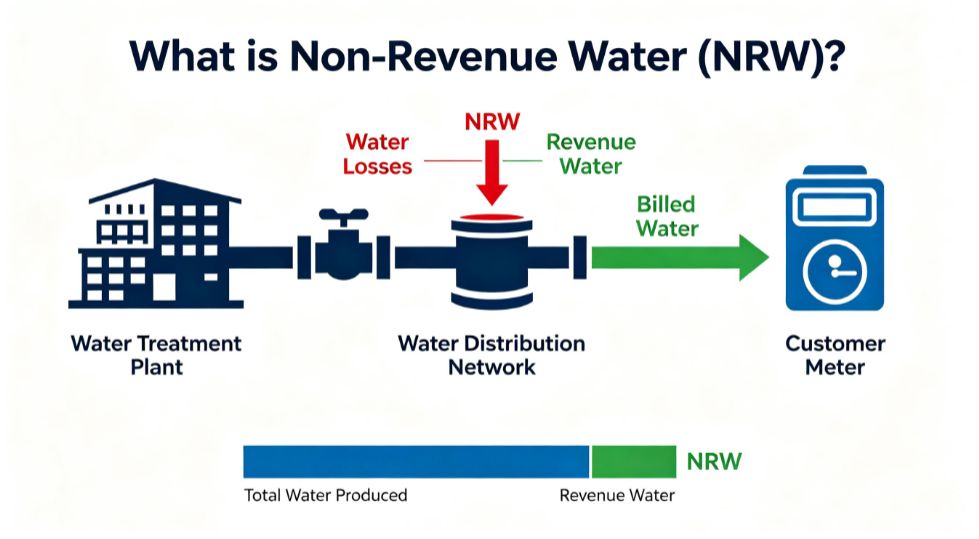
Non-revenue water is the difference between the volume of water put into a distribution system and the volume that is billed to customers.
It is generally divided into three categories:
Reducing NRW is a central focus of water loss management strategies used by modern water utilities.
Leaks in water distribution systems are the most visible form of water lost. These leaks occur in:
Aging infrastructure, poor installation quality, and soil movement often increase levels of leakage over time.
Apparent losses often come from inaccurate or malfunctioning water meters. This includes:
These issues directly reduce revenue water NRW, even when water is physically delivered.
Unauthorized service connections contribute to unbilled consumption. In some regions, this is a significant portion of NRW and is difficult to detect without systematic auditing.
Inaccurate customer databases, missing meter readings, and manual billing errors reduce billed consumption even when water supply is stable.
Excessive pressure in the distribution system increases pipe bursts and background leakage. Without proper pressure management, water loss increases significantly.
High NRW affects water utilities in several ways:
In many developing countries, NRW levels can exceed 30–50%, placing long-term pressure on water systems.
Effective NRW reduction requires a combination of technical, operational, and managerial actions.
Leak detection is a core component of water loss control. Common methods include:
Quick repair cycles reduce water lost from active leaks.
Pressure management helps reduce stress on pipelines and minimizes leakage rates. Techniques include:
Lower and stable pressure levels often reduce background leakage across the distribution system.
Dividing the water supply network into smaller controlled zones allows utilities to:
DMAs are widely recommended by organizations such as the World Bank in NRW reduction programs.
To reduce apparent losses:
This improves billing accuracy and reduces non-revenue discrepancies.
Water utilities can reduce unauthorized consumption through:
Long-term NRW reduction depends on upgrading aging infrastructure:
Modern utilities increasingly use digital tools such as:
Developing countries often experience higher NRW levels due to:
International organizations such as the World Bank support NRW reduction programs through funding, technical assistance, and capacity building for water utilities.
Sustainable NRW reduction is not a one-time project. It requires continuous system management:
A structured approach improves both financial stability and water supply reliability over time.
Non-revenue water is water that is produced and distributed but not billed to customers due to leaks, errors, or unauthorized use.
The three main types are physical losses (leaks), apparent losses (metering and billing errors), and authorized unbilled consumption.
Utilities reduce NRW through leak detection, pressure management, better metering systems, infrastructure upgrades, and improved data management.
High NRW in developing countries is usually linked to aging infrastructure, weak monitoring systems, and limited investment in water loss control.
Pressure management reduces stress on pipes, lowering leak frequency and overall water lost in distribution systems.
Yes. Many NRW reduction measures recover lost revenue and reduce production costs, making water utilities more financially stable in the long term.
Non-revenue water remains a persistent challenge for water utilities worldwide. Through structured water loss management, improved metering accuracy, leak detection, and pressure control, utilities can significantly reduce NRW levels. Over time, these improvements strengthen water supply reliability and support better use of water resources.
