Our website uses cookies which are necessary for running the website and for providing the services you request. We would also like to set the following optional cookies on your device. You can change these settings any time later by clicking "Change cookie settings" at the bottom of any page. For more information, please read our Cookie Information.
These cookies collect information such as how many people are using our website or which pages are popular, helping us improve the customer experience. Disabling these cookies means we won’t be able to collect information to enhance the experience.
These cookies help us understand what interests you so we can show you relevant ads on other websites. Disabling these cookies means we will not be able to show you personalized ads.
Water utilities around the world are under increasing pressure to reduce water loss, improve billing accuracy, and manage distribution networks more efficiently. Traditional mechanical meters have served the industry for decades, but advances in measurement technology have introduced a more reliable alternative: the electromagnetic water meter.
This guide explains how electromagnetic water meters work, their advantages, applications, and why many utilities are adopting them as part of modern smart water management systems.
An electromagnetic water meter is a flow measurement device that calculates water flow using Faraday’s Law of Electromagnetic Induction, making it suitable for measuring conductive fluids in water distribution systems.
An electromagnetic water meter, often referred to as a smart water meter, is a device that measures the volume of water flowing through a pipeline using electromagnetic principles rather than mechanical moving parts.
Unlike conventional meters that rely on turbines or impellers, electromagnetic meters determine flow by detecting the voltage generated when a conductive liquid moves through a magnetic field.
Because there are no internal moving components, electromagnetic water meters maintain measurement accuracy over long periods while requiring less maintenance.
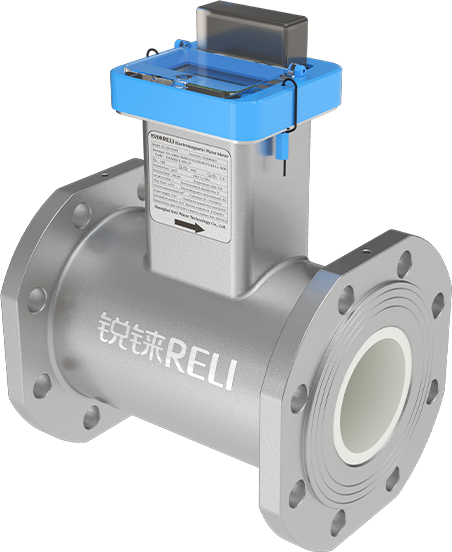
The operating principle is based on Faraday's Law of Electromagnetic Induction.
When a conductive fluid passes through a pipe section surrounded by a magnetic field, an electrical voltage is generated across the fluid. This voltage is directly proportional to the velocity of the fluid.
The meter's electrodes detect this voltage and convert it into flow data.
Because the measured voltage is proportional to fluid velocity, the meter can accurately determine the volumetric flow rate.
Electromagnetic water meters are based on Faraday's Law of Electromagnetic Induction, which states:
E=B×L×V
Where:
As the velocity increases, the induced voltage also increases. The meter converts this relationship into accurate flow measurements.
This principle allows electromagnetic flow meters to provide stable readings even under varying operating conditions.
Electromagnetic technology works only with conductive fluids.
Water naturally contains dissolved minerals and salts, making it conductive enough for measurement in most municipal and industrial applications.
Examples of measurable fluids include:
Non-conductive liquids such as distilled water, oils, and hydrocarbons generally cannot be measured using electromagnetic technology.
| Feature | Electromagnetic Water Meter | Mechanical Water Meter |
|---|---|---|
| Moving Parts | No | Yes |
| Wear and Tear | Minimal | Higher |
| Pressure Loss | Very Low | Moderate |
| Accuracy Stability | Excellent | Can Decline Over Time |
| Maintenance | Low | Higher |
| Remote Communication | Easy Integration | Limited |
| Large Pipe Applications | Excellent | Less Suitable |
For utilities managing large distribution networks, electromagnetic technology often delivers lower lifecycle costs and more reliable long-term performance.
Because there are no rotating components, measurement accuracy remains stable over extended periods.
This is especially valuable for billing applications and water balance calculations.
Mechanical wear is one of the primary causes of meter degradation.
Electromagnetic water meters eliminate many maintenance issues associated with traditional metering technologies.
The measuring tube remains unobstructed, minimizing pressure loss and reducing energy consumption within pumping systems.
Municipal transmission lines often require measurement in larger pipe sizes where electromagnetic technology performs particularly well.
Modern smart water meter systems can support:
Monitoring water output from treatment plants.
Measuring flow throughout transmission and distribution systems.
Supporting non-revenue water reduction programs.
Monitoring pumping efficiency and operational performance.
Providing accurate billing and consumption monitoring.
Tracking water consumption across agricultural networks.
The terms electromagnetic water meter and magnetic flow meter are often used interchangeably.
However, there is a slight distinction:
In practice, both operate using the same electromagnetic principle.
Many utilities are transitioning from traditional meters to smart metering systems to address several operational challenges:
Real-time data helps utilities identify leaks and abnormal consumption patterns.
Accurate flow measurement reduces disputes and revenue loss.
Utilities gain better insight into network performance.
Continuous monitoring supports infrastructure planning and asset management.
As digital water management becomes more common, the role of the smart water meter continues to expand.
When evaluating solutions, utilities should consider:
Verify compliance with relevant metrological standards.
Look for support for:
IP68 protection is often preferred for underground installations.
Long battery life reduces maintenance requirements.
Consider products that comply with:
The next generation of electromagnetic flow meters is becoming increasingly intelligent.
Emerging developments include:
These technologies help utilities move from reactive maintenance toward proactive asset management.
An electromagnetic water meter measures water flow using electromagnetic induction rather than mechanical moving parts. It is commonly used in municipal and industrial water systems.
It generates a magnetic field inside the measuring tube. When a conductive liquid passes through the field, voltage is induced and measured by electrodes, allowing the meter to calculate flow rate.
They are suitable for conductive fluids such as drinking water, wastewater, reclaimed water, and industrial process water.
Faraday's Law states that a voltage is induced when a conductor moves through a magnetic field. Electromagnetic water meters use this principle to measure fluid velocity and flow.
A magnetic flow meter is a general flow measurement device for conductive liquids, while an electromagnetic water meter is specifically designed for water utility applications.
In many applications, electromagnetic meters maintain stable accuracy over longer periods because they have no moving parts that wear out.
Yes. Most modern smart water meter solutions support remote communication, IoT connectivity, and integration with utility management systems.
An electromagnetic water meter combines high accuracy, low maintenance requirements, and advanced communication capabilities, making it a practical choice for modern water utilities. By applying Faraday's Law of Electromagnetic Induction to measure conductive fluid movement, these devices provide dependable flow measurement without the limitations associated with traditional mechanical meters.
As utilities continue investing in digital infrastructure and smart water management, electromagnetic metering technology is expected to become an increasingly common component of efficient, data-driven water distribution systems.
